
You’re probably not doing too much training volume. You’re probably doing stupid volume. Big difference.
I see this all the time. A guy half-asses his working sets, counts warm-ups like they matter, then says he’s “overtrained.” Or he does one psycho leg day with a million sets, can’t walk for four days, and thinks he found the secret. No. The fix is pushing hard, tracking the right shit, and spreading the work like a grown man to drive muscle hypertrophy. Let’s get into it.
The Problem
Most lifters screw this up in one of two ways.
First, they don’t do enough hard work. They train like they’re saving something for later in their resistance training, without sufficiently triggering muscle protein synthesis, then wonder why their body never changes. Second, they go the other way and turn volume into a pissing contest. More sets, more exercises, more junk volume, more fatigue, more bullshit. Then progress stalls and they blame genetics, age, stress, mercury retrograde, whatever.
The old bodybuilding mindset fed this too. If I wanted more leg growth, I’d hear, “Add another leg day.” Fine. But then guys would stack another full dose on top like maniacs, instead of asking a smarter question, which is this: how much work am I doing for that muscle across the whole week, and how should I split it?
That matters because a lot of the older data people leaned on came from beginners. Beginners grow from damn near anything. They recover different, they adapt fast, and their first gains come easy. So if you copy beginner logic as an advanced lifter, you can end up either underdosing or burying yourself.
The Reframe
Here’s the better way to think about it. Training volume works, and more weekly volume often builds more muscle, up to a point. That point is not the same for everybody, and that’s where people get lost.

When researchers pooled the early studies on weekly training volume together, they saw a clear dose-response relationship. Low weekly sets built less muscle thickness than moderate weekly sets, and moderate weekly sets built less muscle thickness than higher weekly sets. In plain English, doing more hard work for a muscle, which generates mechanical tension and metabolic stress, usually beat doing less. The catch was simple though, most of that data came from untrained people, and most of it didn’t push very far past 10 weekly sets per muscle.
So the big lesson wasn’t, “Do infinite volume.” The lesson was, “Stop being scared of volume, but stop being dumb with it too.”
More volume can build more muscle. Stupid volume still buries people.
There’s also another key point here. Weekly volume is not the same thing as one-day punishment. If you spread the work across the week, you can often handle more quality sets, recover better, and grow better.
What I Actually Look At
This is where the gym-bro answer ends and the coaching answer starts.
A solid trained-lifter study pushed this way harder than the early beginner work. These weren’t random newbies. These were trained lifters with years under the bar, around four-plus years on average. They trained full body three times per week. The setup was simple and hard, chest press, shoulder press, pulldown, row, squat, leg press, leg extension. One group did one set per exercise, one did three, one did five. The number of sets varied across groups, but the same movement menu and three training days stayed consistent, with different total volume.
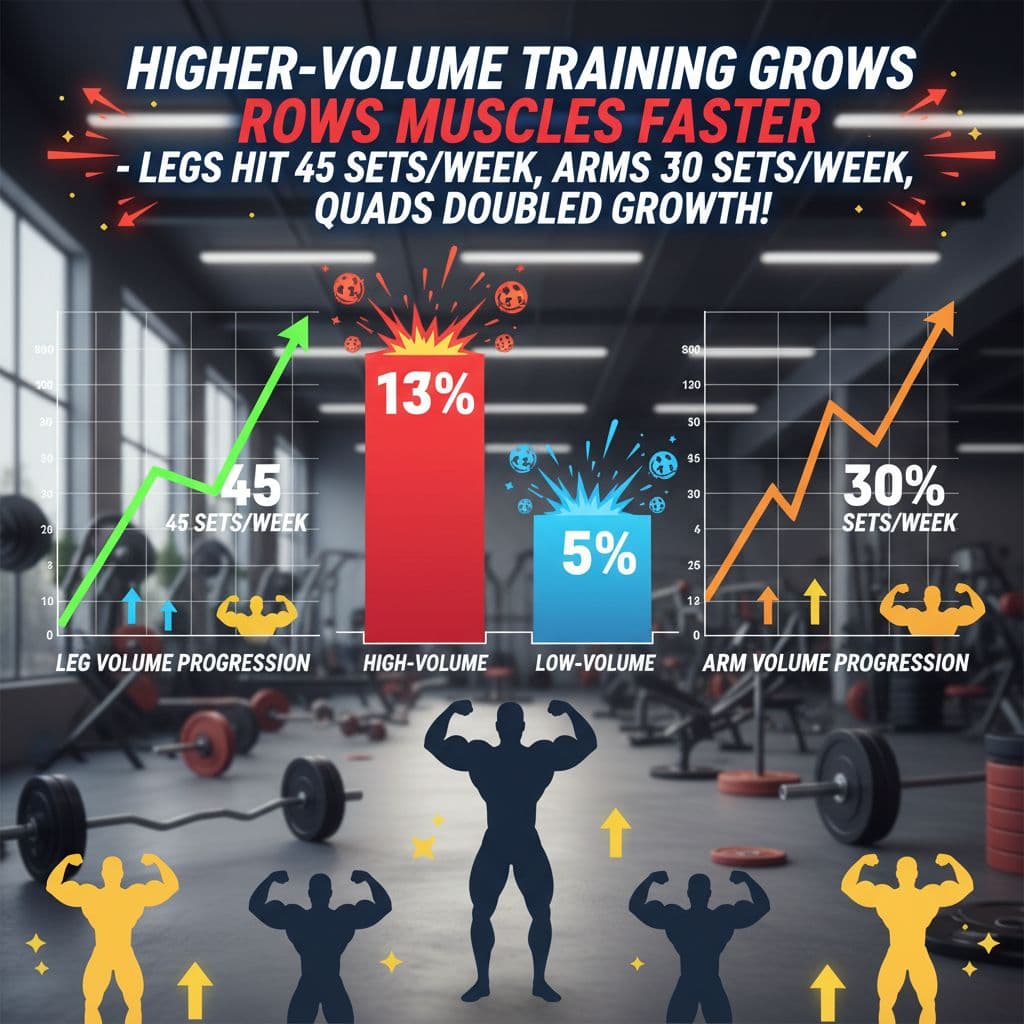
And what happened? The higher-volume group grew more and showed superior strength gains. In the legs, the weekly total got pushed way up, as high as 45 sets per week. For arms it hit 30 sets per week. Over eight weeks, quad growth in the highest-volume group was more than double the low-volume group, roughly 13 percent versus about 5 percent, alongside better 1RM strength improvements.
Now stop right there before your inner idiot starts celebrating. That was 45 sets across three sessions, not 45 sets in one leg workout. That means around 15 sets per session for legs, spread through the week. Huge difference. If you cram all of that into one day, the quality falls off a cliff, execution gets sloppy, your joints start bitching, and the later sets turn into fatigue theater.
That’s why I don’t only ask, “How many sets are you doing?” I ask how those sets are distributed. I want to know if you’re doing 20 good sets for a muscle across two or three exposures, taken close to proximity to failure with a few reps in reserve, or if you’re doing one marathon beatdown and spending the rest of the week limping around like a war victim. Same weekly number on paper can feel totally different in the body.
I also look at the length of the push. The trained-lifter study ran eight weeks. That matters. Short-term, the body can handle more than people think, before muscle damage builds and anabolic hormone response starts to fade. You can push volume hard for a block and get away with it. Keep that pedal down too long, though, and the bill comes due. Sleep starts getting weird. Pumps flatten out. Strength gains stall. Motivation drops. Joints ache in that dull, annoying way that makes you want to skip the hard stuff, signaling the need for better fatigue management. You don’t feel cooked in one dramatic moment. You slowly turn into a bag of shit.
So I think of TRAINING VOLUME like an arc. You can climb it for a while. Then you level off. Then if you keep forcing it, you go backward. That’s the inverted-U idea people talk about. More is better, until it isn’t.
This is why I like periods of higher volume and periods of lower volume. Not random chaos. Not “intuitive training” because you saw one motivational clip and now you think you’re a monk. I mean planned waves through volume cycling. I’ll have a guy build volume over a few weeks, push hard while performance and recovery still look good, then pull back before the wheels come off. That works especially well for hypertrophy-focused lifters. Strength peaking usually means reducing volume and sharpening output, tracking 1RM strength closely. Muscle gain is different. There’s a place for pushing work when the goal is size.
Then there’s the part no spreadsheet can fully solve, the individual response. Group averages lie a little. Not because they’re fake, but because they hide the spread. One guy thrives on high volume. Another guy gets two great weeks and then starts unraveling. I’ve coached natural guys who recover better than enhanced guys. That messes with people because they want a clean answer. Sorry. Human beings don’t work that way. Genetics matter. Stress matters. Sleep matters. Food matters. Work life matters. Your ability to train hard matters. Your ability to tell the truth about your effort matters even more.
That’s why in the real world I watch the basics like a hawk. Are your reps staying clean? Is load or rep performance moving up? Are pumps good? Are you still getting a growth signal without crippling soreness? Is sleep holding? Is appetite stable? Are you beat up everywhere, or tired in the normal productive way? Do you look fuller week to week? If the answers stay good, I can push volume. If those answers start turning ugly, I pull it back.
If you want to see how I structure that kind of progression instead of guessing like a donkey, read the protocol. The whole point is to make volume fit the lifter, not the other way around.
What To Do Instead
Start by counting hard weekly sets per muscle, monitoring your volume load, not random exercises and not your warm-up circus. Then split that work over two or three exposures using fractional sets when you can, respecting training specificity, especially for bigger body parts. If you’re doing 16 hard sets for quads, I’d rather see that spread over the week than jammed into one hero session.
From there, push methodically with progressive overload. Add a little, then judge the response. If performance rises, recovery holds, and your body is changing with muscle hypertrophy and increased muscle thickness, keep going. When progress slows and fatigue starts talking louder than growth, pull back and reset. That’s how grown men train. Not with fear, and not with ego. If you want proof that clean execution beats random suffering and delivers true myofibrillar hypertrophy over transient muscle swelling, see client results showing gains in lean body mass.
If you want me to look at your TRAINING VOLUME and tell you where the volume is helping, where it’s junk, and where you’re lying to yourself, work with me. I’ll clean it up fast, and you’ll stop wasting months doing hard work the dumb way.
Feel good, eat good, fuck good.
Disclaimer This article is for education only. It is not medical advice, diagnosis, or treatment. If you have a medical condition, take medication, use PEDs, or have abnormal labs, get qualified medical oversight before applying any of this.
Author Angelo is a European online coach and a former competitive bodybuilder. He works with serious lifters who want more muscle hypertrophy, better condition, sharper execution with focus on lateral force transmission and connective tissue adaptations, and less guesswork. The job is simple: fix the basics, apply progression properly, manage recovery, and stop doing dumb shit that kills progress.
Scientific References